
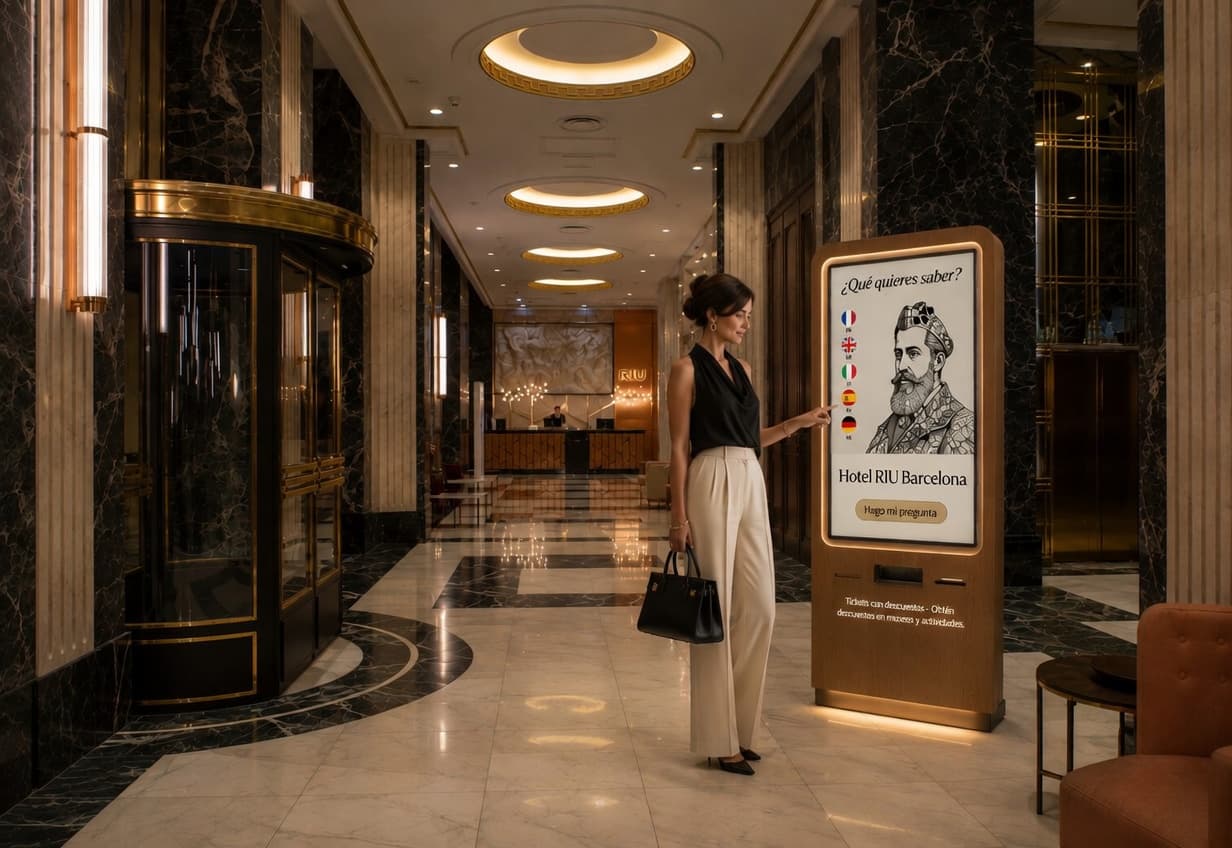
Introduction: why securing action execution from an avatar matters
A reception AI avatar increases accessibility and availability of information, but enabling it to perform real business operations introduces new risks. Allowing an interaction to trigger a booking, ticket printing, physical opening or refund without safeguards exposes the organization to operational errors, potential fraud and traceability issues.
This guide focuses on established patterns to orchestrate and secure those function calls from an avatar deployed on a screen or kiosk. It presents architecture choices, idempotence rules, UX confirmation models, audit requirements and fallback scenarios to staff. The goal is to provide an operational checklist to reduce incidents while preserving a smooth visitor experience.
Which actions to expose from the avatar: prioritization criteria
Before enabling execution, define a clear scope. Not all use cases are equal. Start with low‑sensitivity, high‑user‑value actions, then expand progressively after operational validation.
Choosing which actions to expose requires assessing impact in case of error, authentication needs, financial sensitivity and effects on physical flows. For example, printing information or sending a confirmation email carries low operational risk, whereas refunds, reservation cancellations or door openings require stronger guarantees.
Low‑risk actions: information, printing a receipt, sending a link or QR code (redirecting to an external ticketing service).
Moderate‑risk actions: creating a tentative reservation, authenticating a customer account, requesting paid options that require validation.
High‑risk actions: payments, refunds, changes to physical access (door opening), irreversible cancellations.
Recommended architectures to orchestrate calls
Avoid letting the avatar call each business system directly. A robust pattern is to place an orchestration layer or a broker/middleware that centralizes security, validation, queuing and compensation logic.
This broker performs several roles: authenticate and authorize requests, enforce business rules (quotas, limits), inject correlation identifiers for traceability, manage queuing and retries on unavailability, and expose secure endpoints to target systems. Depending on the setup, the avatar can trigger signed webhooks to this broker or call functions exposed via secured APIs.
Securing calls: authentication, authorization and network protections
Security relies on several complementary layers. Use TLS for all exchanges between the avatar, the broker and business systems. Beyond encryption, apply strong service‑to‑service authentication (mutual certificates, signed tokens) and restrict privileges by the principle of least privilege.
For sensitive operations, plan progressive step‑up authentication. The avatar may initiate an action after an initial check (e.g. identifier check), then request stronger confirmation before actual execution (one‑time code, confirmation via mobile app). Finally, protect against repudiation and denials by retaining request identifiers and signatures for each transaction, which facilitates audits and investigations.
Idempotence and compensation mechanisms: preventing side effects
A key principle for actioning calls is idempotence: ensure that the same resent request does not produce duplicate effects. Implement unique request identifiers (idempotency keys) at the broker level and, when possible, have business systems recognize and honor those keys.
For operations that cannot be made strictly idempotent, plan compensation mechanisms. For example, if a reservation change fails mid‑process, define a rollback scenario or a compensating operation (cancel the attempt and notify). Clearly document compensation limits and the windows during which a rollback is feasible.
User confirmation models and reassuring UX on screen or kiosk
Designing confirmations is critical to avoid human errors and disputes. For any consequential action, the visitor must receive an explicit, visible and, when appropriate, vocal confirmation. The wording should state the action, its consequences, possible costs and offer a clear pre‑execution cancel option.
On a kiosk or screen, combine visual and vocal elements according to the interaction. For example, after a refund request, display the operation summary, require explicit validation (tap 'Confirm' or say 'Yes'), then provide a transaction proof (reference number) and guidance on next steps. These steps support traceability and reduce contestation risk.
Auditability and monitoring: what to log and how to structure traces
To make actions traceable and auditable, capture at minimum: session identifier, user identifier (if available), idempotency key, timestamp, requested action, outcome (success/failure), error codes and the cross‑system correlation identifier. These elements must be linked across the avatar, the broker and business systems to reconstruct a complete timeline.
Audit logs must be protected against tampering and retained according to your organisation's retention policy. It is recommended to export health and error metrics to a separate monitoring system to detect anomalies quickly and trigger investigation procedures.
Error handling and fallback scenarios to a human operator
Even with robust architectures, errors occur. Define clear behaviors depending on the error type: transient errors (controlled retry), application errors (notification and rollback if necessary), and security errors (block and alert). Never assume an automatic transfer to a human agent without an associated process.
Provide clear exit messages for the visitor in case of failure, explaining status and possible actions (retry, contact reception, leave contact details). For sensitive operations, the procedure can explicitly invite the user to go to the desk or contact support, and record the attempt in logs so staff can resume the case with full context.
Operational checklist before production rollout
Before allowing actions in production, validate a set of technical, organisational and legal items. Involve security teams, operations and business owners to verify liability boundaries and define escalation procedures.
Tests should include end‑to‑end scenarios in an environment close to production, broker load tests, idempotence validations (resending requests), rollback trials, penetration tests of exposed endpoints and user acceptance sessions to check confirmation clarity.
Definition of the scope of allowed actions and required authentication levels.
Deployment of a broker/middleware with idempotency keys and request correlation.
Secure endpoints (TLS, mutual authentication or signed tokens) and a rights policy.
End‑to‑end test scenarios, error tests, load tests and security tests.
Logging and audit trace retention policy, with restricted access.
Business procedures for staff take‑over (escalation procedures) and training.
FAQ
Question: Can the avatar process a payment directly?
Answer: The avatar can initiate the payment process, but executing a payment typically requires a dedicated integration with a payment provider and regulatory requirements. A dedicated integration can let the avatar orchestrate a payment via a secure broker or redirect the user to a payment terminal. Any connection to a payment provider must be treated as a specific integration and include strengthened security controls.
FAQ (continued)
Question: How to guarantee traceability when multiple systems are involved?
Answer: Use correlation identifiers propagated via the broker to all involved systems, keep the idempotency key and timestamps, and centralize audit logs. These elements enable reconstruction of the event chain without making technical assumptions about third‑party internals. Effective traceability depends on the integrations implemented between the broker and business systems.
Conclusion
Allowing a reception AI avatar to trigger business actions is feasible if orchestration, security and audit patterns appropriate to the risk are adopted. Best practices include using a central broker, idempotence, explicit UX confirmations, correlated audit logs and clear fallback procedures to staff.
SANIA can be configured to trigger function calls and webhooks toward an orchestration architecture, and to deliver adapted on‑screen and vocal confirmations according to the defined persona. To explore how these patterns can integrate with your infrastructure and ensure secure, traceable execution, you may request a demonstration of SANIA.