
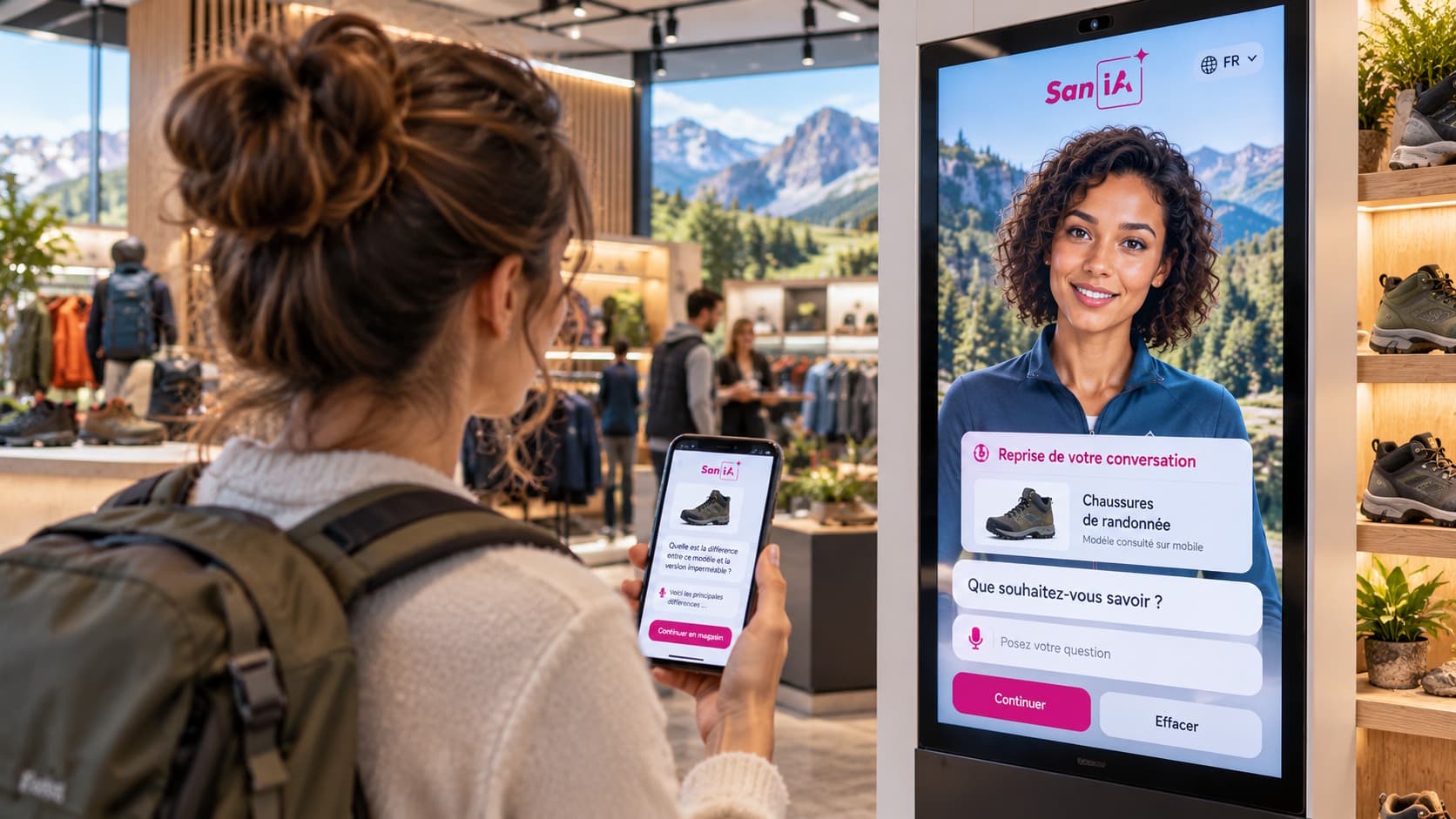
Introduction: why real-time requires architectural choices
Connecting an AI avatar deployed on a screen or kiosk to business systems (POS, inventory, CRM, booking) is not only a question of API access. It is about ensuring that the information shown to the visitor is consistent, up to date and served with latency compatible with a conversational interaction, while keeping API call costs under control and guaranteeing production resilience.
This article addresses the technical and organizational choices that help meet these goals: when to orchestrate flows, when to prefer an event-driven architecture, how to design robust APIs and webhooks, which cache strategy to adopt, and how to plan graceful degradation of the user experience. Runbooks, test models and practical checklists complete the guidance.
Orchestration versus choreography: picking the right pattern
Two families of architectures are common to integrate business systems: centralized orchestration and choreography (event-driven architecture). Each approach has advantages and limits depending on the need for consistency and the nature of the third-party systems.
Orchestration: a central component (API gateway, BFF, orchestrator) coordinates all requests to POS, inventory and CRM. Advantages: centralized visibility of flows, control over retry and quota policies, easier SLO management. Limits: risk of a single point of failure and increased load on the orchestrator if not sized correctly.
Choreography: systems communicate via events (webhooks, event bus). Advantages: better decoupling, scalability, potentially lower latency for some interactions. Limits: complexity in managing consistency and distributed transactions.
Practical advice: prefer orchestration for critical synchronous actions (availability check at checkout, instant reservation) and choreography for non-blocking state propagation (stock synchronization, promotion notifications).
Designing resilient APIs and webhooks
The quality of APIs exposed by business systems and the endpoints you develop is decisive. Here are design rules to follow to minimize production errors.
Idempotent endpoints and clear verbs: for business actions (reservations, cancellations), designing idempotent APIs makes retries safe without double execution. Using request identifiers provided by the client allows detecting and ignoring duplicates.
Contracts and versioning: precisely documenting schemas (payload, error codes) and applying clear versioning avoids regressions during evolution. Contract mocks are useful for continuous integration tests.
Resilient webhooks: provide retry mechanisms on the sender side, exponential backoffs and identification headers for validation. Avoid unauthenticated webhooks; use an HMAC signature or token to validate the origin of notifications.
Cache, invalidation and consistency: a practical strategy
Cache reduces latency and API cost, but introduces the challenge of consistency. Rather than a universal rule, here are patterns applicable depending on data criticality.
Short-lived read cache: for non-critical but frequently accessed information (product pages, approximate availability), a short-duration cache can improve the avatar’s responsiveness. Use short TTLs and conditional validation logic (ETag/If-Modified-Since) when the API supports it.
Event-driven invalidation: for inventory and promotions, prefer proactive invalidation via webhooks or event messages sent by the source system. As soon as stock or a promotion changes, publish an event that triggers targeted cache invalidation.
Client-side and edge cache: in some setups, maintaining an edge cache (CDN or a layer close to the device) reduces perceived latency. Be careful with consistency for transactional operations: for these, read the source of truth rather than the cache.
Quota management, latency and SLO/SLA
POS or booking APIs may impose quotas or present variable latencies. To design a robust service, defining operational objectives is necessary — without claiming universal numbers.
Define internal SLOs for the avatar: for example, maximum allowed time to answer an exploratory request versus a blocking action. These SLOs help prioritize calls (e.g. read requests are lower priority) and choose degradation behavior.
Circuit breakers and quotas: implement circuit breakers to avoid overwhelming a struggling third-party service, and apply throttling at the orchestrator to respect quotas. When a service is restricted, fall back to cached data or propose a UX alternative.
Observability of latencies: instrument external calls with traces and metrics (latency p95/p99, error rate) to detect degradations and trigger the appropriate runbook.
Graceful degradation and user experience (UX) during outages
When business systems do not respond, the avatar must remain useful. The UX degradation strategy is a key part of operational design.
Inform rather than hide: the avatar can clearly tell the visitor that it cannot access real-time information, and offer useful alternatives (general information, opening hours, redirect to a human service).
Substitution modes: display cached information (with freshness indication), offer an appointment or a pre-request (collect contact details for a callback), or provide offline options if performing an integrated action is not possible.
Voice considerations: for voice interactions, plan short responses and recovery prompts to avoid the conversation stalling when external data is missing.
Testing, validation and incident runbook
The robustness of an integration is proven by tests and incident preparedness. Here is a set of validation methods and a concise operational runbook.
Automated tests: include unit tests on API adapters, integration tests against contract mocks and end-to-end tests on environments that reproduce the latency and errors of business services.
Resilience tests: simulate failures (timeouts, 5xx, network interruptions), reached quotas and corrupted responses. Tests must cover retry, idempotence and rollback scenarios.
Minimal runbook to prepare (example steps):
Detect the incident via alerts (5xx errors, increase in p99 latencies).
Identify the affected scope (POS, inventory, CRM) and activate a configured degraded mode for the avatar.
Switch critical endpoints to mocks or to an updated cache layer if possible.
Notify business teams and trigger the communication plan to impacted sites.
Log actions and prepare a post-mortem to fix weak points (contracts, timeouts, capacity).
RAG, multi-LLM and real-time data: how to reconcile
Using a knowledge base to enrich answers (RAG) and orchestrating multiple LLM engines influences how real-time data are integrated.
Separate uses: assign RAG the static or periodic information (FAQ, business rules) and query business APIs directly for critical and volatile data (stock, instant availability, booking).
Real-time contextualization: when the avatar must compose a response mixing RAG knowledge and real-time data, order the calls to limit latency — for example, call the critical source first and then enrich with RAG if the latency budget allows.
Multi-LLM and routing: depending on the setup, it can be useful to route certain request types to a specialized LLM (dialogue, summarization) and others to a model optimized for factual verification. These choices should be tested to measure impact on latency and cost.
Practical checklist and operational examples (retail and hospitality)
Here is a checklist to use during design and pilot preparation, followed by two concrete illustrative examples. The checklist targets key decisions and validations before putting the avatar into production.
Integration checklist:
Identify synchronous use cases (e.g. stock check for purchase) and asynchronous ones (e.g. price update propagation).
Choose the main architecture pattern: orchestration for synchronous / choreography for event propagation.
Document API contracts and set up contract mocks.
Define cache strategy and invalidation mechanisms (webhooks or messages).
Plan circuit breakers, throttling and retry rules (with idempotence).
Prepare the incident runbook and UX degradation messages; validate with user testing if possible (touch and voice).
Examples (illustrative)
Retail — product availability and promotion: the avatar reads inventory to indicate local availability. Recommended pattern: orchestrator that reads the inventory source for checkout decisions, and cache invalidation via webhook emitted by the WMS when stock or markdown operations occur.
Hospitality — booking and check-in: for a booking request, use a synchronous orchestrated interaction with the booking system to obtain an instant confirmation. In parallel, feed the RAG knowledge base with non-critical information (opening hours, services) to enrich the exchange.
Conclusion and next steps
A reliable real-time integration between an AI avatar and business systems requires thoughtful choices on architecture (orchestration vs choreography), resilient API and webhook design, an adapted cache strategy and ready-to-use runbooks. The trade-off between latency, cost and consistency is decided case by case according to business priorities.
SANIA can be configured to interact with webhooks, call external endpoints and leverage a knowledge base for RAG, while being deployable on touch/voice screens or kiosks and integrated with the Sandisplay ecosystem depending on the project. To study how these patterns apply to your environment (retail, hospitality, multi-site), you can request a targeted SANIA demonstration.