
Introduction
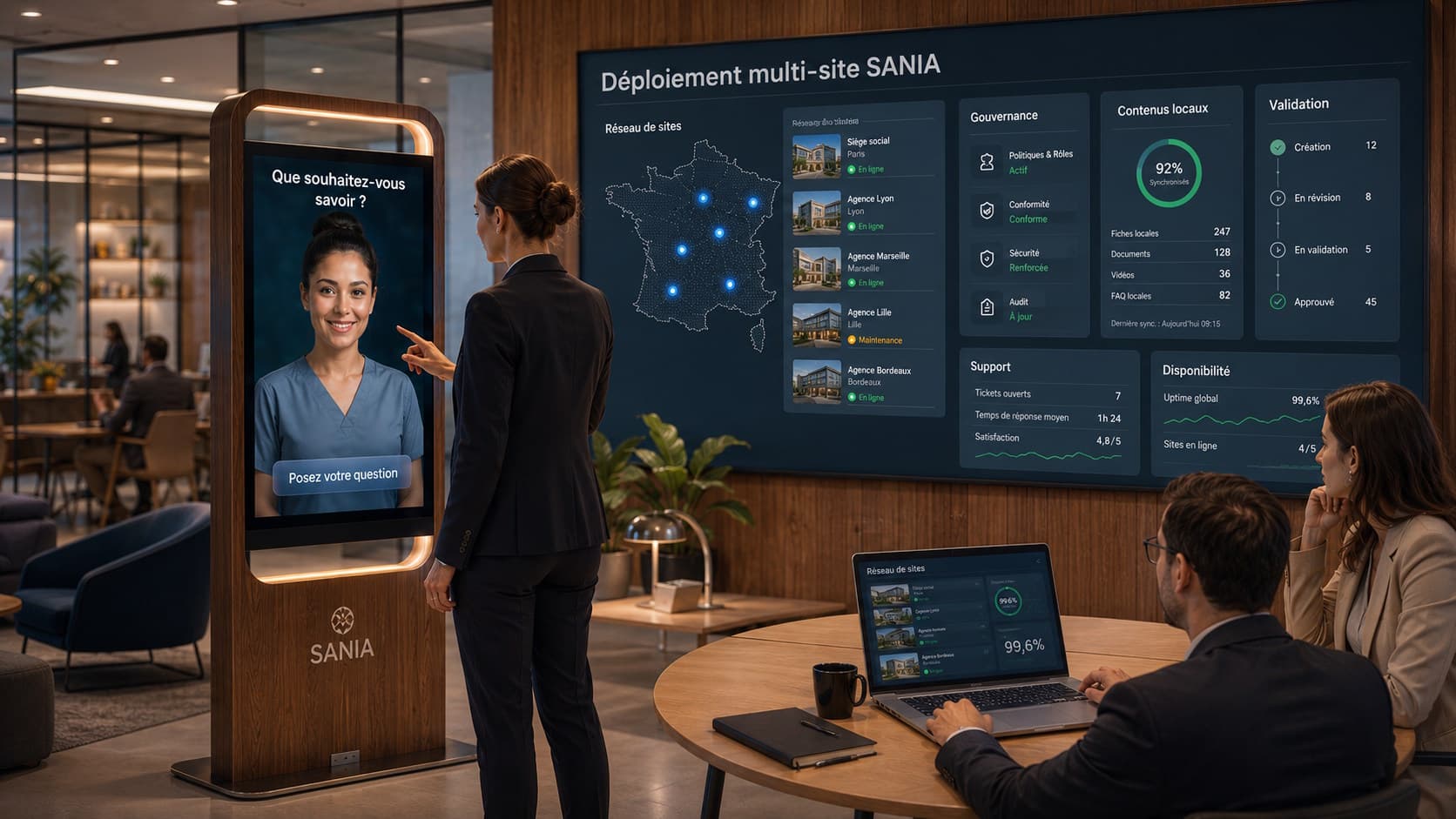
Deploying an AI avatar on a single screen is a project. Rolling it out across a network of sites adds several operational and organizational dimensions. The challenges are not only technical. They concern information consistency, editorial responsibility, local content localization and the capability to maintain the service on a daily basis.
This article describes the main decisions to take before a multi-site deployment, proposes governance models suited to the context, details how to prepare and synchronize local contents, and lists operational watch points for running the service. Where relevant, we indicate how SANIA can fit into these choices, being explicit about native capabilities and required integrations.
Why multi-site changes the game
A multi-site deployment confronts the organization with variability in audiences, usage patterns and schedules. A standardized response may suffice for common institutional information, but each site can have locally sensitive information: different opening hours, specific events, local contacts, and particular accessibility constraints.
The main risk is dilution of responsibility. Without clear rules, local information becomes outdated or contradictory. Moreover, update management takes on another dimension: friction must be minimized so local teams can quickly correct an error while preserving overall consistency.
Possible governance models
There are several models to allocate responsibilities between central level and local sites. Three common approaches are the centralized model, the decentralized model and the hybrid model.
The centralized model favors editorial consistency by concentrating content creation and validation at the central level. It limits divergences but can slow local updates and increase the central documentation team's workload.
The decentralized model gives greater autonomy to local teams to manage their information. It improves reactivity but requires clear rules and local editorial skills to avoid inconsistencies.
The hybrid model combines a centrally managed information core with locally editable blocks. This compromise often suits organizations that want to keep brand communication while giving operational flexibility to sites.
Organizing the knowledge base and content
An avatar's answer quality depends directly on the quality of its knowledge base. For a multi-site deployment, it is useful to define content categories and clear management rules: what belongs to the common core, what is local, and what constitutes temporary information.
Favor content written clearly, dated and signed by a responsible person. Specify simple workflows for content creation, validation and updating. These workflows should indicate who can publish, who must validate and how to document the history of changes.
Also anticipate the need for fallback content when a local piece of information is missing. For example, providing a generic response that refers to a contact or a reference page avoids giving incorrect answers rather than displaying unverified information.
Localization and multilingual without complicating management
On a multi-site network, the question of languages and localization is often central. SANIA can communicate in more than 100 languages, which facilitates linguistic coverage, but the quality of multilingual answers depends on the quality and freshness of the business contents provided.
Rather than translating the entire base manually, favor a pragmatic strategy: identify the contents truly required in each relevant language according to each site's audience. Define who is responsible for linguistic validations and how to correct errors found in a foreign language.
For local adaptation, distinguish translation of information (same content, different language) from localization (content adapted to site-specific particularities). Governance rules should specify in which cases local teams may modify a translation or add formulations specific to the territory.
Infrastructure, integrations and operational availability
Multi-site deployment raises infrastructure and integration questions. Ensure that screens and kiosks can access the intended version of the knowledge base, and specify how connectivity loss cases will be handled.
SANIA can be integrated with screens and interactive kiosks and be part of a digital signage ecosystem such as Sandisplay. Depending on the chosen architecture, some functions or synchronizations will require specific development work or connections to local systems.
Also anticipate the organization of hardware and software maintenance: who handles software updates, kiosk reboots, network monitoring and first-level on-site interventions. Simple and accessible operational instructions must be provided to local teams.
Managing operations and organizing support
Multi-site operations require clear roles and processes to respond quickly to incidents and to maintain content quality. Define levels of responsibility: central content owner, local correspondents, the technical team in charge of screens, and a route for escalating business questions.
Although SANIA can maintain session context and exploit an organization's knowledge base, nothing replaces a human support chain to handle uncovered cases. Plan rules to direct a visitor to a human contact when information is not available or when the situation requires it.
Here is a practical operational checklist useful for the operations phase:
Governance document published and shared among sites
Content validation process and responsible persons identified
Localization rules defined for local contents
Offline update procedure and plan for connectivity loss
Technical support plan and local contacts clearly displayed
Frequent errors and watch points
Failing to formalize governance. Leaving content management to ad hoc practices quickly leads to inconsistencies between sites. Formalizing roles and workflows is essential to remain reactive and consistent.
Multiplying local versions without control. Allowing all teams to freely edit local contents can solve one-off cases but makes long-term maintenance impossible. Prefer measured permissions and documentation of changes.
Neglecting training for local teams. Local correspondents must know how to correct information, report anomalies and transmit user feedback. A short initial training and a practical guide are often sufficient to avoid most errors.
Forgetting about updates. Dated contents or temporary information not removed create distrust. Plan regular reviews and simple mechanisms to remove or archive obsolete information.
FAQ
Should the entire knowledge base be duplicated for each site?
Not necessarily. It is advisable to keep a common core for shared information and to identify editable slots for site-specifics. This limits duplication and simplifies governance.
Can the avatar automatically provide local information based on the screen's location?
The ability to automatically adapt an answer according to location depends on the project's configuration and integrations. It is important to distinguish what is project-specific configuration and what is a native avatar capability.
To go further
Before launching a multi-site rollout, organize a workshop bringing together business owners, local correspondents and technical teams. The goal is to align expectations, design governance and define an initial content scope for a representative pilot.
A multi-site pilot, even limited, allows you to validate update processes, assess local teams' ability to manage the knowledge base and adjust operational documentation. Pilot duration and scope depend on the organization's objectives and resources.
Conclusion
Deploying an AI avatar across multiple sites is first and foremost an organizational and content project. Choosing an appropriate governance model, clarifying responsibility for local contents and anticipating operational maintenance prevents most difficulties.
SANIA can provide a customizable, multilingual AI avatar integrable with screens or interactive kiosks. To confront these governance rules with a concrete solution and study their application to your site network, you can request a demonstration of SANIA.