
Quick introduction: the right trade-off depends on your priorities
Choosing between edge, cloud or a hybrid architecture to deploy an AI avatar on a kiosk or display is not a technology fad but an arbitration between real constraints: voice pipeline latency, protection of business documents used for retrieval, multisite operating costs, 24/7 maintenance capabilities and tolerance to network failures. This guide proposes a pragmatic decision framework, concrete architecture patterns compatible with common OS and SoC families (Samsung Tizen, Android, Windows depending on configuration), business scenarios and an operational pilot checklist.
Criteria matrix to compare architectures
Before choosing, position your priorities on a simple matrix grouping the following dimensions: user latency (ASR, LLM, TTS), data confidentiality and location (RAG and business documents), total cost of ownership across sites, operability and 24/7 maintenance, scalability and ability to deploy model or content updates.
For each dimension, identify whether it is a hard requirement, an acceptable compromise or a lower priority for your organization. For example, if real‑time vocal reception with no perceptible delay is critical, latency becomes a top priority and favors an edge‑first architecture or a hybrid with local voice processing. If confidentiality of internal documents is paramount, prefer handling embeddings and document retrieval within infrastructure you control (edge or private cloud depending on policy).
Three operational architecture patterns
1) Edge‑first: local voice processing and RAG prioritized. In this pattern, ASR and TTS can run locally on the kiosk (or on a nearby local server) to minimize voice latency perceived by users. sensitive document search (embedding creation and semantic search) is hosted locally or within a controlled network perimeter. Generation LLMs can be hosted locally if hardware and licensing permit, or called in the cloud for more complex requests applying a local filtering policy.
2) Cloud‑first: centralization and scalability. The cloud hosts ASR, LLM, TTS and the RAG knowledge base. This model simplifies maintenance, eases model updates and reduces load on kiosks. It can however introduce additional latency and requires robust network guarantees and contractual protections for data confidentiality when content transits to cloud services.
3) Partitioned hybrid: pragmatic balance. The hybrid approach splits components according to sensitivity and expected latency. Example partitioning: ASR and audio preprocessing at the edge to capture speech quickly, embeddings and RAG search at the edge or in a private cloud to protect business content, and generation LLM in the cloud to benefit from greater capacity and frequent updates. This pattern enables partial offline resilience: when cloud access is unavailable, the avatar can continue to answer common cases from local knowledge.
Business scenarios and practical recommendations
Urban retail: high‑traffic stores require smooth, multilingual interactions. If in‑store voice use is primary and latency is sensitive, favor a hybrid pattern with ASR/TTS at the edge and LLM in the cloud. Protect commercial content (product sheets, promotions) via RAG segmentation and encryption.
Public reception and administration: document confidentiality is often a priority. An edge‑first or hybrid architecture with local document management reduces outbound flows while maintaining acceptable voice experience.
Events and temporary contexts: rapid deployment, simple maintenance and cost considerations can favor a cloud‑first solution, possibly combined with local caching capabilities to ensure controlled degradation in case of network loss.
Distributed multisite deployments: when rolling out to a large heterogeneous fleet, account for local network capabilities, OS/SoC variety and data governance. The hybrid pattern eases functional standardization while allowing local configurations adapted to each site’s constraints.
Impacts on RAG and embeddings: privacy, freshness and corpus size
Where the RAG service is hosted directly affects privacy and the ability to guarantee up‑to‑date answers. Hosting the embedding index locally reduces transfers of sensitive documents but requires distributed refresh and maintenance processes. Placing embeddings in the cloud simplifies updates and industrialization but requires contractual guarantees and encryption measures during transfers.
The embedding refresh strategy must be operationally designed: define who can trigger an update, what human validation is required and how to roll back to a previous version if a regression is detected. These rules are independent of the edge/cloud choice but their operational implementation will vary by architecture.
LLM, TTS and ASR updates in production: governance and rollout
Updating models and components requires a clear workflow. Identify the roles responsible for model selection, quality testing and production deployment. For cloud‑first components, updates can be centralized and rolled out quickly. For the edge, plan a distribution process for binaries or containers to kiosks, progressive tests and a rollback mechanism.
In a hybrid pattern, favor blue/green or canary approaches to limit regression risk across a heterogeneous fleet. Document the tests to perform before deployment: perceived latency, ASR quality in target languages, TTS coherence and the suitability of generated responses against the business knowledge base.
Degradation runbook and graceful fallback strategies
Anticipate network outages or cloud unavailability by defining clear degradation behaviors. Example operational rules: when the LLM service connection is degraded, fall back to predefined responses or to a local FAQ subset; when cloud ASR is unavailable, use a simplified local model or offer touch interaction; if the RAG index is unreachable, inform users the avatar will provide general answers and suggest alternative channels for sensitive requests.
The runbook must specify alert sequences to operations, recovery checks and human actions to take. It is important not to claim an automatic transfer to a human agent without proper integration and processes: instead, plan the cases where the avatar will direct users to staff and describe how the team will take over.
Operational pilot checklist before industrialization
Before expanding the deployment, validate a structured pilot covering the following points. This checklist accounts for multilingual constraints, target OS and SoC and 24/7 operations:
Define priorities on the latency/privacy/cost/operability matrix.
Choose the architecture pattern (edge‑first, cloud‑first, hybrid) and document component partitioning (ASR, TTS, LLM, RAG).
Validate the RAG pipeline: document provenance, possible anonymization, embedding refresh frequency and rollback procedure.
Plan latency and ASR/TTS quality tests in target languages under real noise conditions.
Set up the degradation runbook and alert playbooks for 24/7 operations.
Define the model update process and test criteria before production for both edge and cloud.
Additional operational aspects: cost, maintenance and OS/SoC
Total cost of ownership strongly depends on fleet size and chosen pattern. Cloud‑first architectures can reduce local maintenance complexity but generate recurring costs tied to model calls and centralized storage. Edge‑first architectures increase on‑site hardware and software maintenance but can lower operational costs related to traffic and improve latency.
Practically, verify compatibility with the OS and environments supported by your project. SANIA can be deployed on professional Samsung displays in their SoC/Tizen environment, via an Android application on some compatible platforms or within adapted Windows environments. The choice influences update packaging and operational constraints.
Conclusion and next practical steps
The right choice depends on a combination of priorities: if voice latency and document protection are critical, favor an edge‑first or hybrid approach with local handling of sensitive flows; if you prioritize ease of operations and scalability, a cloud‑first architecture may be preferable. In most multisite cases, a partitioned hybrid architecture provides an attractive operational compromise.
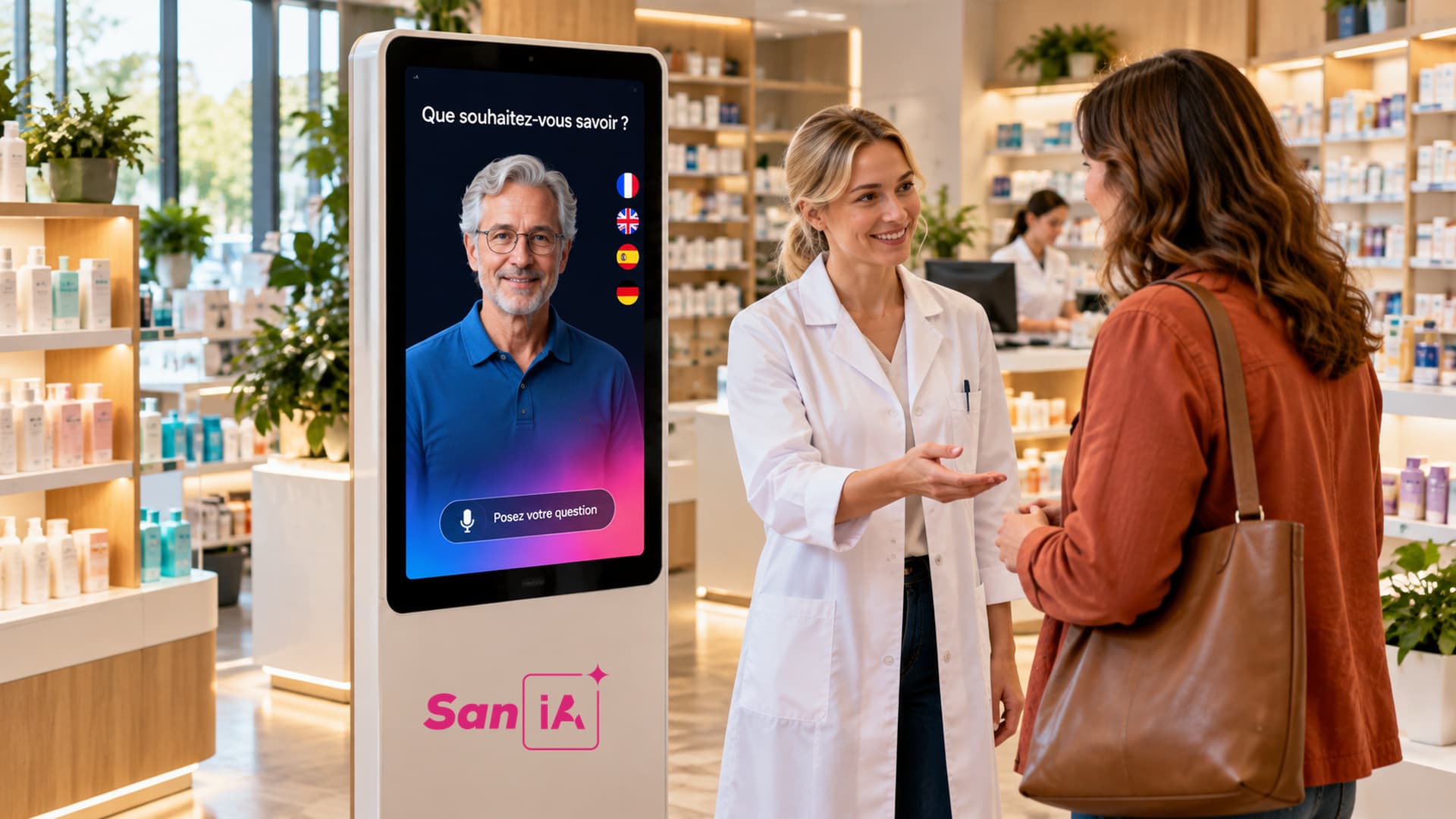
SANIA offers a professional conversational AI avatar usable on touchscreens or interactive kiosks, with voice and touch interaction depending on configuration, available 24/7 and able to communicate in more than 100 languages. To evaluate concretely which architecture best fits your fleet, request a demonstration to explore integration patterns, impacts on RAG/embeddings and a tailored pilot plan.