
Introduction: scope and stakes
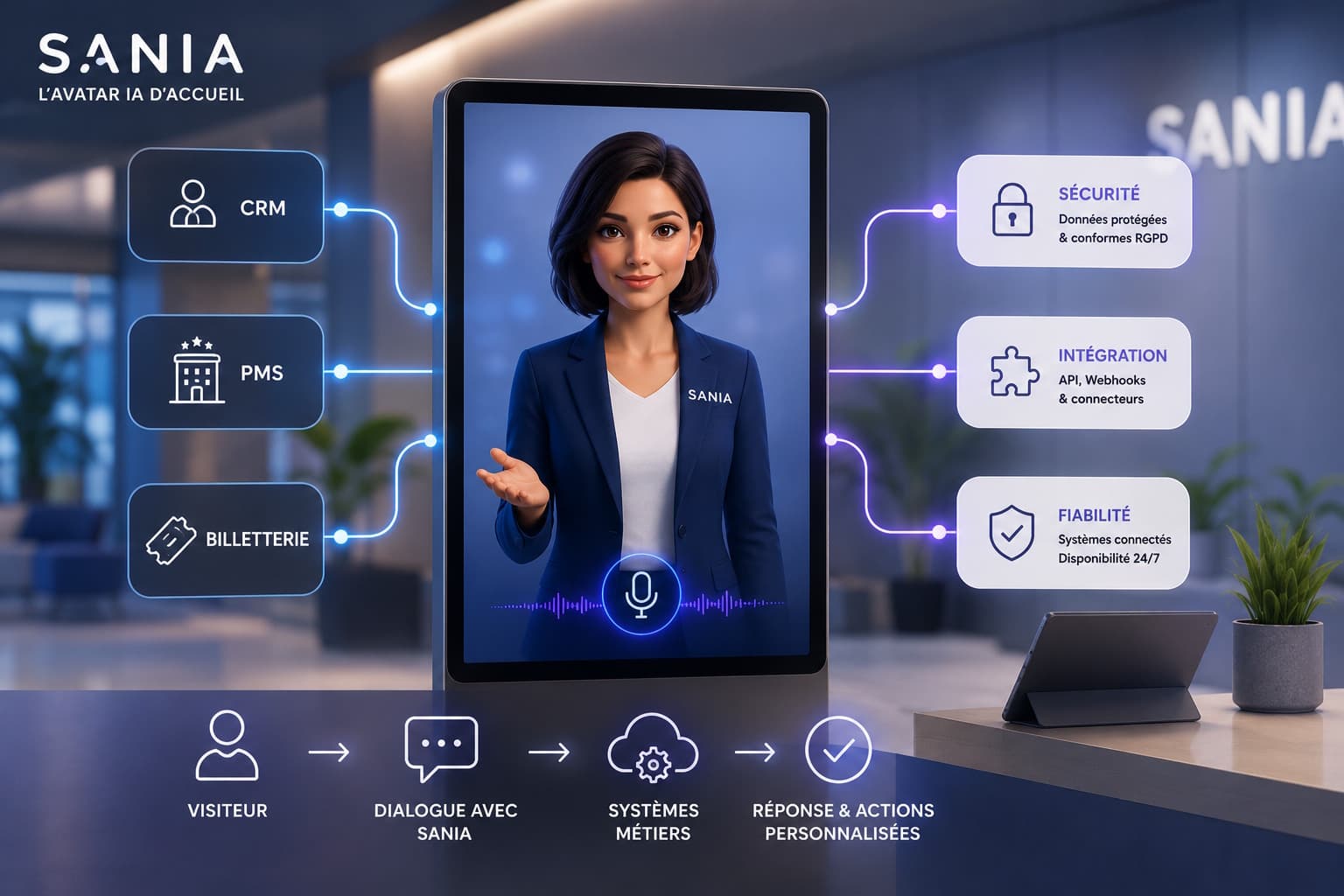
A reception AI avatar can enrich the visitor experience by providing information and directing people on a screen or interactive kiosk. To become genuinely useful, it is often necessary to connect it to existing business systems: customer CRM, hotel PMS, online ticketing or ERP. This article presents, from an operational standpoint, the most common integration patterns, possible architecture schemes, security imperatives and the validations to conduct before going live.
The objective is not to list out‑of‑the‑box integrations, but to help a CIO, CTO or project manager assess technical feasibility, operational impacts and the risks to anticipate when making an AI avatar interact with back‑office systems.
Integration patterns: read‑only, real‑time queries and transactional actions
Three families of technical patterns cover the majority of use cases:
1) Read‑only. The avatar queries sources to provide non‑sensitive information: opening hours, service descriptions, publicly available availability. This pattern limits risk because it does not introduce writes into business systems and simplifies operational compliance.
2) Real‑time queries. The avatar issues requests to internal APIs to obtain an up‑to‑date state: reservation status, room availability, loyalty account balance. These accesses require robust handling of authentication, latency and the scope of exposed data.
3) Transactional actions via webhooks or function calls. In some scenarios the avatar can initiate an operation in a third‑party system — for example create a reservation request, trigger a pre‑confirmation or report an incident. These actions need idempotence mechanisms, upstream business validations and clear governance. Note that any action modifying a system requires a specific integration and agreements on operational responsibilities.
Architecture schemes to consider
Three architecture schemes commonly recur depending on project complexity and security requirements: lightweight API proxy, event broker and RAG (retrieval‑augmented generation) for document search.
API proxy. A centralized proxy between the avatar and business APIs enables uniform controls — authentication, rate limiting, response normalization and centralized logging. This scheme is suitable when the organization wants fine control over accesses without modifying existing systems.
Event broker. For asynchronous interactions or to decouple load and latency, a broker (queue or topic) can buffer transactional requests. The avatar publishes a message, a business consumer executes it and returns an acknowledgment. This scheme facilitates operational resilience and integration with existing business flows.
RAG vs direct queries. When the avatar relies on a business document base, semantic search (RAG) allows exploiting PDFs, product sheets and documentation without constantly querying business APIs. However, for sensitive or dynamic information (reservation status, payment), direct queries to the source of truth should be favored.
Security and privacy requirements
Integrating an AI avatar raises security and privacy questions that require clear decisions up front. Here are the essential points to address:
Authentication and authorization. Favor standard mechanisms (OAuth2, short‑lived tokens, scopes) and apply the principle of least privilege for accounts used by the avatar. Avoid exposing long‑lived keys in public interfaces.
Encryption and transport. All communications must transit over encrypted channels (TLS). Secrets and keys should be stored in a secure vault and not embedded in clear text in code or configuration.
Data minimization. Transmit to the avatar only the data strictly necessary to produce a response. If personal data is processed, define retention periods and deletion rules. Whether a data protection impact assessment (DPIA) is required depends on the actual processing and the level of risk for the data subjects.
Resilience, idempotence and offline fallback strategies
Third‑party system outages are a reality. It is therefore essential to design resilience mechanisms: idempotence for transactional requests to avoid duplicates, clear error handling and retry strategies with backoff on the integration server.
If a business API is unavailable, plan degradation behaviors: switch to read‑only mode, use a cached version of non‑sensitive information, or return a guidance message inviting the user to contact staff. Depending on configuration, SANIA can be connected to fallback mechanisms to maintain an information service while avoiding irreversible actions.
Tests and validations before production
Before any public deployment, run test campaigns covering several axes:
Functional and integration tests. Verify response consistency across all priority use cases, test authentication chains and simulate third‑party system errors to validate fallback behaviors.
Security and compliance. Perform penetration tests on exposed access points and review authentication configurations. Verify personal data handling flows and prepare the documentation required by compliance teams.
Usability and acceptance tests. Validate interaction ergonomics (voice and touch as configured), clarity of error messages and alignment of responses with business rules. Involve frontline teams to adjust scenarios.
Concrete scenarios by sector
Hospitality – PMS. An avatar can inform about reservation status, check‑in hours or available services. For any action that modifies the PMS (express check‑in, reservation change), a specific transactional integration is necessary and must include security validations, idempotence and shared operational responsibility between the hotel and the integrator.
Ticketing. The avatar can propose schedules, check event availability and point users to ticketing. Triggering a purchase or issuing a ticket requires direct integration with the ticketing platform and guarantees on payment handling and customer data.
Retail and CRM. The avatar can consult customer records or loyalty status to personalize an interaction. Any modification to a customer record or the application of benefits must pass through secure flows and business rules validated by the CRM team.
Watchpoints and common mistakes
Certain mistakes recur in integrations: granting excessive rights to the avatar interface, failing to anticipate asynchronous error cases, underestimating network latencies or neglecting multilingual impacts on business content. It is also common to forget governance of content exposed via RAG or external documentation, which can lead to outdated responses.
Another pitfall: confusing informational assistance with automated action. Any automation of a business operation requires a clear definition of responsibilities, validation rules and manual recovery procedures in case of failure.
Checklist of questions to ask your integrator (and SANIA)
Before launching a project, ask these precise questions to evaluate the technical solution, security and operations:
Which integration pattern do you recommend given our needs: read‑only, real‑time queries or transactional actions?
How will authentication and authorization be handled (tokens, scopes, rotation)?
Which architecture scheme do you propose: API proxy, event broker, or a mix of both?
How do you handle idempotence and the security of transactional actions initiated by the avatar?
Which data will be sent to the avatar and how do you ensure minimization?
Which fallback scenarios will be activated if third‑party systems are unavailable? Can we switch to read‑only? (depending on avatar configuration)
Conclusion and next steps
Connecting a reception AI avatar to your business systems is entirely feasible but requires clear technical and organizational choices. Between access patterns, architecture choices, security requirements and fallback scenarios, success depends on precise definition of access scopes, data governance and tests conducted before public opening.
SANIA is a conversational AI avatar solution that can be configured to use function calls, webhooks and a knowledge base specific to your organization depending on the chosen setup. To evaluate the best architecture for your context and confront these options with your technical and security constraints, you can request a demonstration and an analysis workshop with our teams.