
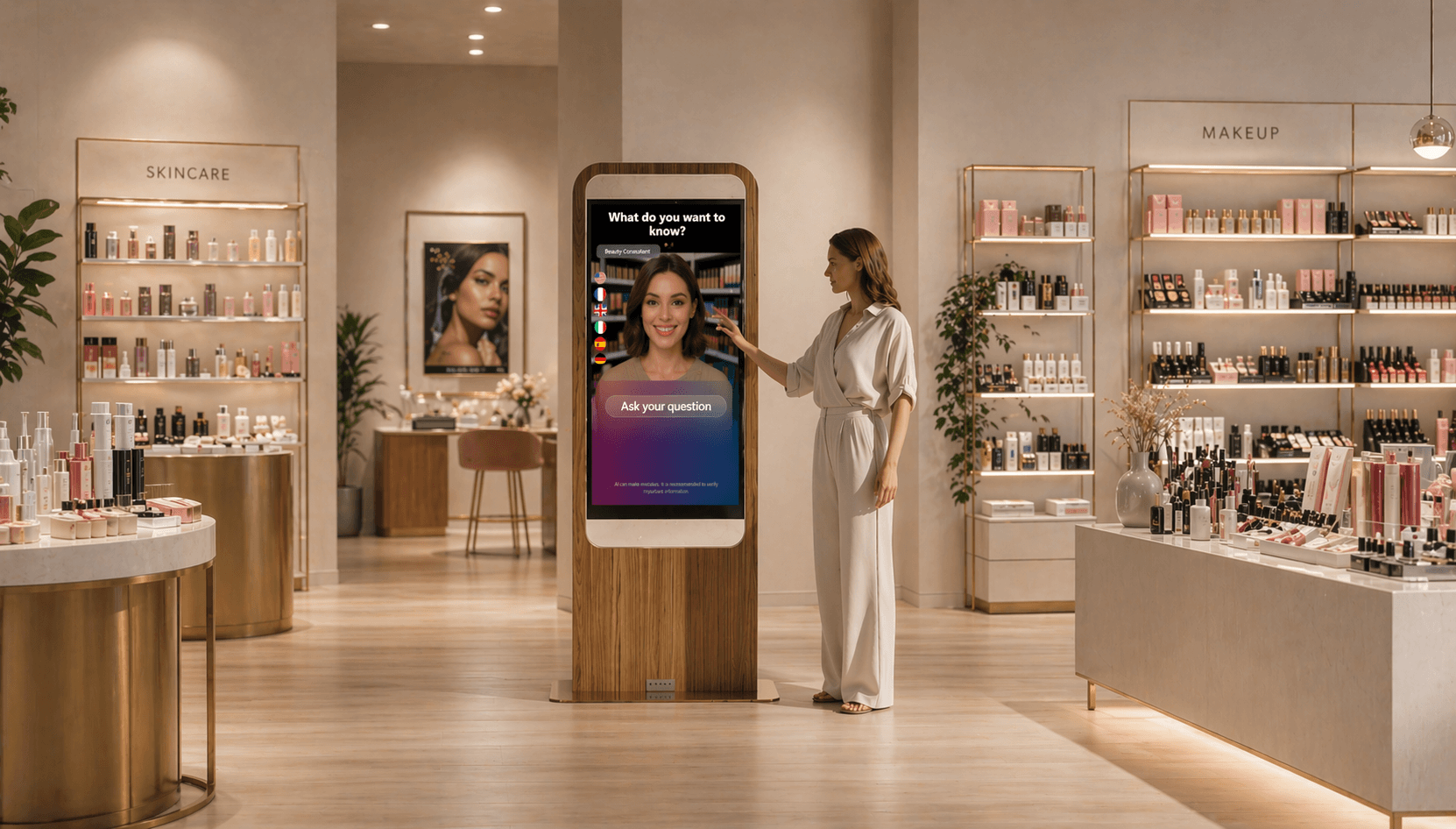
Introduction: objectives and scope
This guide targets IT managers, omnichannel project leads and solution architects preparing a pilot of an in‑store AI avatar. The objective is practical: define reliable integration patterns so the avatar can query operational data (stock, promotions, POS, CRM) and, when write‑integrations are planned, trigger actions without compromising latency, security or privacy.
We consider an AI avatar deployed on a screen or interactive kiosk capable of function calls, webhooks and orchestration with a RAG knowledge base to enrich business responses according to the project setup. This document presents architecture choices, security best practices, fallback strategies and an operational checklist to run a retail POC.
Priority use cases to select for a pilot
Before any technical integration, prioritise a small number of actionable, high‑value use cases. Relevant examples for a store pilot: checking if a product is available on shelf or in back stock, retrieving applicable promotions for a product code, consulting basic customer history from POS/CRM to contextualise the conversation, proposing a local hold or reservation when a manual confirmation by staff is acceptable.
Choosing simple cases reduces integration surface and eases end‑to‑end testing. For each case, specify precisely the read data required and the write actions allowed, and identify which operations need a specific integration to a third‑party system.
Technical integration patterns
Several patterns can coexist depending on functional requirements and infrastructure constraints. Below are commonly adopted patterns and their recommended uses in retail.
Direct API calls (synchronous REST/gRPC) from the avatar backend: suited for data that must be fresh to the second and whose call latency is controlled by the infrastructure. These are specific integrations and require orchestration on the server side.
Function calls / service orchestration: use serverless functions or microservices to encapsulate business logic (auth, transformation, promotion rules) and expose endpoints dedicated to the avatar. This pattern helps separate responsibilities and centralise logging without directly exposing core systems.
Webhooks and events: useful to push events (stock updates, promo activation) to an orchestration layer. Webhooks are good to propagate changes but do not replace an on‑demand read when an immediate answer is required.
Queue / message bus for asynchronous processing: for actions that do not need an instant response (for example, creating a back‑office hold), placing the request on a queue ensures durability and recovery in case of incidents.
Cache and scalable read layer: introduce an intermediate cache layer to relieve transactional systems and reduce latency for frequent queries. The cache must be invalidated or refreshed according to business events signalled by webhooks.
Deciding between real‑time and refreshed data
The choice between real‑time queries and using refreshed data depends on the business need, the criticality of the data and tolerance for inaccuracy. For a stock check where accuracy is critical before an in‑store action, a real‑time call or a final verification against the POS/stock service is preferable. For general promotion info or approximate availability, a recent cache may suffice.
Consider these factors: importance of freshness for user experience, capacity of back‑end systems to handle frequent queries, acceptable user latency and complexity of business logic to apply on the avatar side. When a real‑time integration is implemented, encapsulate call and retry logic in an orchestration layer to avoid technical debt inside the avatar itself.
API security and anonymisation of sensitive data
Connecting an avatar to operational systems introduces security and privacy risks. Treat these integrations as sensitive interfaces: implement strong authentication, role‑based access control and monitoring of calls. Use restricted tokens and limit scopes to strictly necessary operations.
For privacy, adopt data minimisation: surface only information useful to the conversation and, where possible, encrypt data in transit and at rest. Before using customer data from CRM or POS, assess anonymisation needs and consult the compliance officer. Processing personal data and retaining interaction traces depend on the project configuration and organisational decisions.
Error handling, retries and fallback strategies
Real systems fail. Design flows to tolerate interruptions and provide a coherent user experience. Practical principles: wrap each external call in a control layer that handles timeouts, exponential retries and circuit breakers; provide conciliatory responses when data is unavailable; and distinguish temporary errors from functional errors.
On failure, the avatar must offer a fallback: reply with generic information from the RAG knowledge base, suggest the guest waits or redirect to staff. Any critical action proposal (for example a reservation or stock operation) must be qualified by the avatar as contingent on human confirmation when the write integration is not fully automated.
High availability and operational robustness
To guarantee a 24/7 experience, plan isolation and recovery mechanisms: redundancy for critical services, entering a degraded mode if a backend is unavailable and failing over to validated caches or static content. The design should allow distinguishing a temporary outage from a prolonged disruption to adapt the level of information offered to the user.
Document clearly the scenarios where the avatar switches to degraded mode and provide operations teams with simple runbooks to restore connections. Ability to restart a message queue cleanly or to purge an invalid cache are routine operations to include in the pilot plan.
RAG orchestration and operational data
When the avatar uses a RAG knowledge base, orchestrate the combination of document‑based answers and live operational data. For instance, an initial textual answer can be composed from validated documents, then enriched by an API call to include in‑store availability or the current promotional price.
This orchestration is a project configuration. Define clear rules: which sources take precedence in case of conflict, how to indicate the information origin to the user and what checks to perform before showing sensitive data. Keep orchestration logic in an intermediate layer to ease updates and audits.
Testing, acceptance and POC: an operational method
A POC must validate end‑to‑end flows and behaviours under real conditions. Build test scenarios covering normal cases, high latencies and partial outages. Also test error handling, retries, degraded mode entry and proper anonymisation of data returned by APIs.
Involve business teams in acceptance to validate response quality and fallback acceptance. Use representative test datasets without exposing production: preproduction environments simulating response times and error codes from real systems make qualification possible without operational risk.
Operational checklist to run the deployment
Before launching a store pilot, verify a set of practical items: clear definition of use cases, list of required APIs and access scopes, availability of mocks or sandboxes for testing, anonymisation and log retention rules, monitoring plan and incident runbooks, fallback modes and RAG contents to use in degraded mode.
Also ensure support teams know how to escalate an interaction to staff and that store operations have been briefed on system limits. Formalise POC success criteria and how feedback will be collected to iterate on the integration.
Define priority use cases
List APIs, scopes and security constraints
Prepare sandboxes and test datasets
Define fallbacks and RAG content for degraded mode
Create runbooks and monitoring plan
Train store teams on pilot scope
Practical FAQ
How to verify that an action proposed by the avatar is actually executed in the back‑end?
It is recommended to implement a transactional acknowledgement via the orchestration layer. When the write integration is configured, the function that enqueues a request or calls the service should return a clear status the avatar can use to inform the user. This implementation is a specific integration and depends on the connected systems.
What to do if the POS refuses an operation for business reasons? Provide an explicit user message and escalate to human verification.
Can the avatar read the CRM? Yes, in an adapted configuration. Limit exposed fields and anonymise identifiers according to privacy policy.
Conclusion and next steps
Making an AI avatar truly actionable in stores requires combining pragmatic architecture choices, strict security rules and robust testing procedures. Prioritise simple use cases, encapsulate integration logic in intermediary services, plan acceptable fallbacks and formalise privacy requirements before any access to sensitive data.
SANIA can be configured to call functions, use webhooks and orchestrate responses enriched by a RAG knowledge base to deliver business information and, when a specific integration is implemented, initiate actions. To study how these patterns could apply to your store estate, you can request a SANIA demonstration and share your priority use cases.