
Introduction: the challenge of a consistent multilingual base at reception
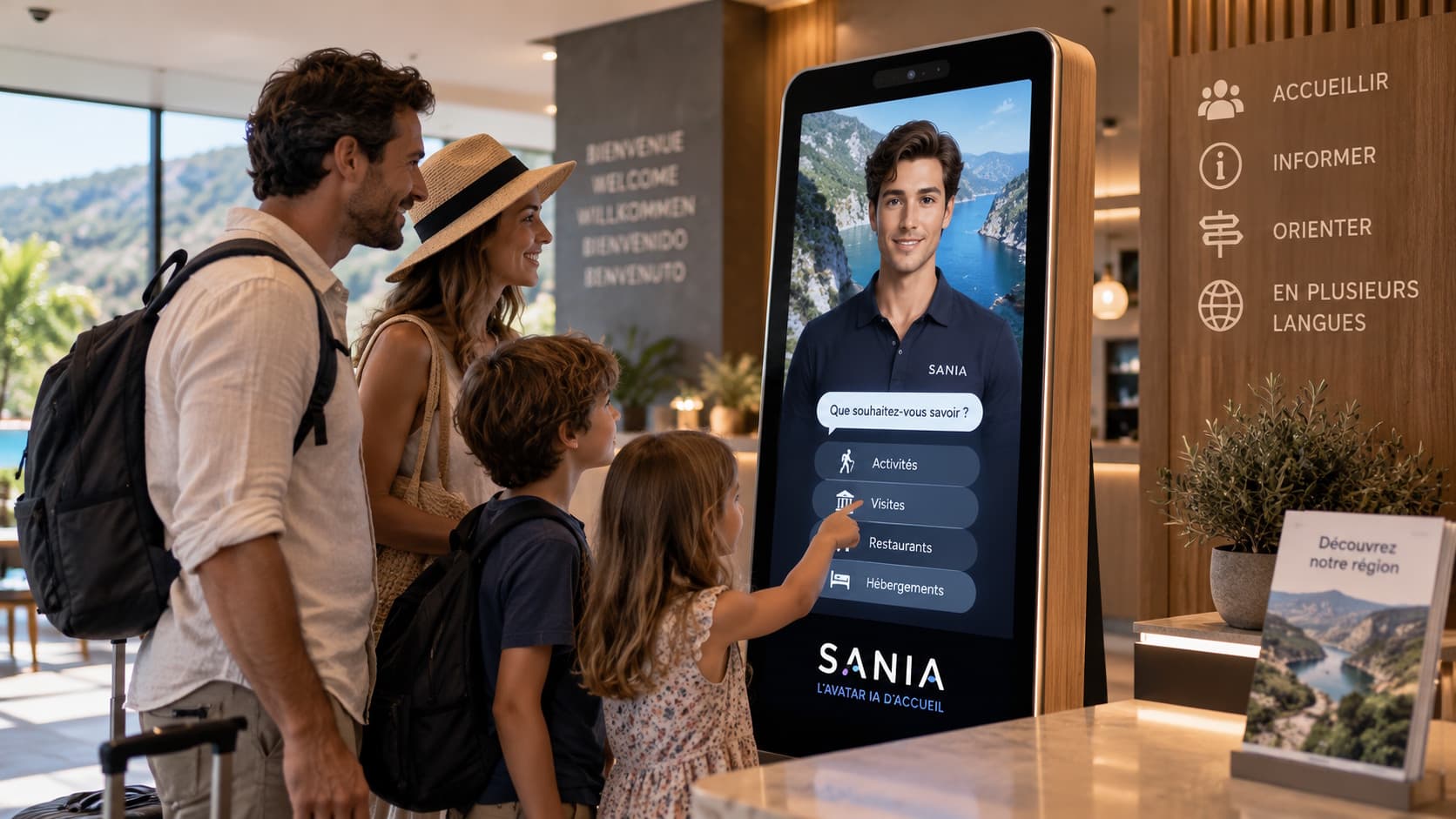
An AI avatar deployed on a screen or kiosk in a public space must provide coherent, easily understood answers in the languages spoken by visitors. Managing a multilingual knowledge base goes beyond translating documents: it requires aligning canonical content, semantic search indexing and quality-control procedures so the retrieval-augmented generation (RAG) system remains performant and predictable.
This operational guide details practical workflows, technical choices for ingestion and embeddings, linguistic QA rules, as well as fallback scenarios and cost-control levers to consider before deploying a multilingual reception AI avatar.
Choosing a multilingual content strategy: three compared approaches
Three main workflows emerge for producing and maintaining content:
1) Single canonical source then translation: keep a ‘‘source’’ corpus in the primary language, translate into other languages and maintain traceability between versions. This approach simplifies editorial governance and centralized updates.
2) Separate corpora by language: each site or entity produces native content per language. This suits multi-site organizations where local information differs significantly and native quality is prioritized over inter-language consistency.
3) Machine translation (MT) followed by human post-editing: useful when volumes are large and publication latency must remain low. Post-editing targets high-visibility or sensitive content to ensure quality.
Single source + translation: better editorial control, easier to maintain.
Separate corpora: better local adaptation, higher governance cost.
MT + post-editing: fast and cost-effective for volume, requires review SLAs.
How to choose according to your context
The decision depends on business constraints: content heterogeneity between sites, update volume, translation budget and required language quality. For a centralized reception with short technical contents, single source + translation is often effective. For a network with local offers and different events, favour separate corpora or a hybrid model: shared canonical content plus native local blocks.
Whatever the choice, it is important to define content ownership, validation roles and a synchronization process between languages.
Multilingual ingestion pipeline to the vector database
Multilingual ingestion aims to produce vectors that are relevant for semantic search. The pipeline typically includes: source preparation, normalization and segmentation, metadata extraction, embeddings generation and insertion into the vector database.
Plan from the ingestion phase for clear metadata: language, version, update date, source and criticality level. These metadata ease priority management during queries and maintenance operations.
Common input formats accepted: PDF, DOCX, XLSX, TXT, CSV, and structured formats like NDJSON as required.
Segment documents into semantic units (paragraphs, FAQs, fact sheets) to optimize vector granularity.
Multilingual embeddings: options and impacts on relevance
The choice of embeddings directly affects RAG result quality across languages. Three options exist: monolingual embeddings per language, single multilingual embeddings, and a hybrid strategy.
Multilingual embeddings enable similar content in different languages to be close in a shared vector space, which facilitates cross-lingual answers. Monolingual embeddings can offer finer local nuance but often require routing mechanisms between indexes.
The hybrid strategy indexes by language while keeping a transversal index for some shared content. This compromise helps preserve local relevance while allowing retrieval of useful resources in another language if the local corpus is insufficient.
Single multilingual: operational simplicity and better results for multilingual queries.
Monolingual per language: increased local precision, higher management complexity.
Hybrid: good compromise depending on corpus size and language diversity.
Language detection, fallback and response prioritization
Detecting the input language is a practical step to select the index and the response policy. Depending on configuration, an AI avatar can be set to recognize and adapt to the session language.
If no relevant content exists in the requested language, define fallback rules: offer a short response in another language, provide automatically translated elements noting that post-editing will follow, or direct the user to human resources. These scenarios should be decided by the organization and communicated to teams.
Prioritize native or validated content in the user's language.
Provide a transparent notice if a response comes from automatic translation.
Answer quality and linguistic testing
Multilingual QA combines linguistic and factual checks. Define clear quality criteria: factual accuracy, tone aligned with the persona, readability and respect for local guidelines. QA must cover newly ingested content and frequent updates.
Organize linguistic acceptance tests using representative sampling: common scenarios, ambiguous queries, sensitive questions and local requests. Involve human reviewers for priority languages and use targeted post-editing to correct machine-translated or machine-generated content.
Cross-language consistency tests: verify translated versions convey the same information.
Conversation scenarios: include follow-ups and prompts to test context retention.
Organization, governance and translation SLAs
Governance should define who produces, validates and publishes content for each language. Establish editorial roles: content owners, language validators and a knowledge-base manager. For machine translation and post-editing, formalize SLAs and priorities: which content requires systematic human review and which can be published with controlled MT quality.
Anticipate budget by distinguishing recurring translation costs, one-off update costs and vector database maintenance charges. A written policy facilitates decision-making during urgent updates.
Monitoring, metrics and running tests in production
Even if some metrics are not provided natively by an avatar solution, define a measurement plan that includes collecting problematic examples, tracking user feedback and regular human reviews. An organization may choose to record sessions for QA purposes according to its privacy rules.
Plan test cycles after each major update: linguistic tests, verification of newly ingested documents and simulation of unforeseen queries. Adjust search weights or replace embeddings if relevance drift is detected.
Schedule regular reviews for priority languages.
Collect unresolved queries to refine the corpus and segmentation.
Watchpoints and common mistakes to avoid
Common mistakes include publishing unchecked translations for sensitive content, neglecting language metadata at ingestion, and indexing overly large documents without segmentation. Other risks: lack of version traceability, complicating corrections after incidents, and diffuse governance that prevents quick decisions during critical updates.
Fixing these issues requires clear workflow rules, audit tools and appropriate indexing granularity.
FAQ
Do you need to translate the entire knowledge base into every language?
Not necessarily. It is better to cover first the content that is truly useful to target audiences and prioritize translation or post-editing for high-visibility items. Less critical content can be offered via an automatically translated fallback while awaiting review.
How to manage frequent updates across multiple languages?
Adopt a workflow where changes to the canonical content clearly trigger translation or version-alignment actions. Version traceability and metadata are essential to manage these tasks without error.
Conclusion
Managing a multilingual knowledge base for a reception AI avatar requires thoughtful choices between quality, cost and maintenance. By combining a clear editorial workflow, structured ingestion to the vector database, appropriate embedding choices and continuous linguistic QA, an organization can ensure a more consistent experience for its visitors.
SANIA can be configured to provide multilingual conversational reception on a screen or kiosk, relying on a knowledge base specific to your organization and LLM engines according to the planned configuration. To explore how this approach could integrate with your environment, you can request a demonstration of SANIA.