
Introduction
Preparing a financial dossier to secure funding for a pilot or rollout of a reception AI avatar requires a clear, repeatable framework. This guide presents an operational method to calculate total cost of ownership (TCO), structure a return-on-investment (ROI) model, and prepare the assumptions needed for approval by management or finance.
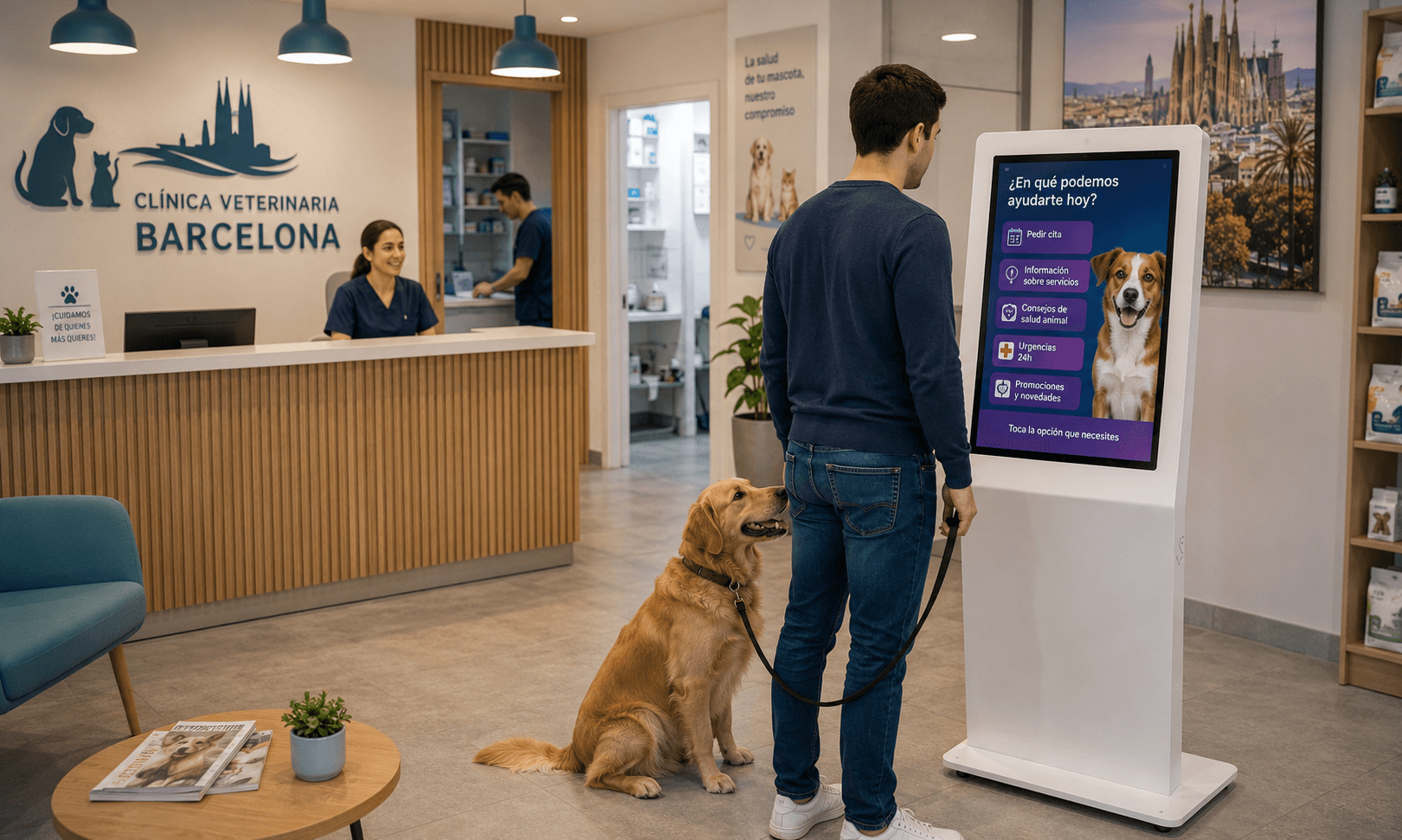
The focus is on specifics related to a solution deployed on screen or interactive kiosk, including typical SANIA configurable choices such as voice versus touch interaction, use of a RAG system and the choice of an LLM engine. Wherever a capability depends on an integration or configuration, this will be indicated.
Why formalize a TCO and ROI specific to a reception AI avatar
Reception AI avatars on screens or kiosks do not have the same cost lines as a simple SaaS application. They combine hardware, LLM hosting, document indexing, integrations with business systems and operational running costs. Formalizing a TCO makes these lines visible and helps anticipate financial risks related to the pilot or scaling up.
An ROI model based on explicit assumptions helps discussions with the CFO and CIO: it shows which savings and gains can be targeted, which metrics to track and how sensitivity to main variables (LLM cost, number of screens, content refresh frequency) affects profitability.
Main cost lines to include
Below are the items to systematically include in a TCO model for a reception AI avatar. This list distinguishes direct costs, recurring expenses and supporting expenditures.
Hardware and installation: purchase or lease of screens or interactive kiosks, mounts, cabling, installation and any furniture adaptations.
Software and licenses: license for the avatar solution (depending on configuration), digital signage licenses if related, back-office platform costs.
LLM and RAG costs: LLM query consumption (cloud usage or chosen engine), hosting of the vector database, initial document indexing and regular re-indexing processing.
Technical integrations: development or configuration to connect the avatar to business systems (directory, internal FAQ, CMS, information displays) — note each integration is specific.
Voice and interface: synthetic voice licenses or voice cloning (when planned and authorized), UX adaptation for voice vs touch, accessibility testing.
Operations and maintenance: application support, knowledge base corrections and updates, infrastructure monitoring, security updates and possible SLAs for 24/7 availability (SANIA’s capacity indicated).
Step-by-step method to calculate TCO
1. Define the temporal scope of the model: reference period for the analysis (for example pilot period then a multi-year horizon for rollout).
2. Inventory the items: use the previous list and quantify each item according to the scope (number of screens, number of sites, content refresh frequency).
3. Differentiate CAPEX and OPEX: initial hardware capital, then recurring operational costs (LLM, hosting, maintenance).
4. Handle variable costs: for LLM usage, model expected consumption (query volume, share of long responses, voice usage) and apply an estimated unit price according to the considered offers. Specify that these estimates depend on the chosen provider and generation parameters and are presented as working assumptions.
How to build an ROI model adapted to physical reception
The ROI of a reception AI avatar is built by comparing the TCO to the set of measurable and plausible benefits. These benefits are not limited to staff cost savings: they can include improved resolution rate for common requests, availability of information outside opening hours, fewer wayfinding mistakes and the value of offering an additional service to visitors.
In a financial dossier, choose benefits that are directly measurable and verifiable during the pilot. For example: reduction in calls to a specific reception desk, average response time for standard information, volume of interactions outside opening hours. Note that collecting these indicators requires an appropriate measurement method and is not provided by SANIA out of the box without specific configuration.
Sensitivity scenarios and best practices for assumptions
Build at least three scenarios to add robustness to the dossier: conservative, central and optimistic scenarios. Vary key assumptions: LLM cost per query, number of daily interactions, avatar resolution rate, frequency of knowledge base updates.
Specify operational assumptions: who is responsible for updating content, planned re-indexing frequency, whether interaction is voice, touch or mixed (reminder: voice and touch interaction are configurable choices depending on the project). Also mention whether LLM hosting is planned on public cloud, on a third-party engine or at the edge (according to the selected technical configuration).
Hypothetical numeric example (for illustration only)
The following example is entirely hypothetical and only serves to illustrate the structure of a TCO/ROI model. It should not be interpreted as an estimate applicable to a real case without adjustment.
Scope assumption: pilot at 1 site, 1 interactive kiosk, 12-month period.
Initial CAPEX: interactive kiosk and installation (amount to be estimated locally), visual and voice customization (if requested).
Annual OPEX: platform subscription, estimated LLM and RAG usage costs, support and maintenance, voice licenses.
Benefits considered: replacement of some staffed information hours during the targeted day, reduction of repetitive requests to staff, perceived visitor value outside opening hours.
Sensitivity: if LLM cost increases by X% or if interactions double, show the impact on OPEX and the financial breakeven point.
Budget checklist before submitting the dossier
Before submitting your business case, verify that each item is justified and responsibilities are assigned. This checklist aims to reduce common objections from IT and finance.
Pilot scope and success criteria clearly defined.
Hardware quotes with installation and maintenance options.
Estimated LLM consumption and cost scenarios (documented variables).
Integration plan listing systems to connect and who performs each development (internal role or contractor).
Operations plan: who updates the knowledge base, review frequency, support arrangements.
Measurements and metrics planned during the pilot and the collection method (who collects and how).
Ready-to-use assumptions template
Here is a set of assumptions to complete for your dossier. Fill in values according to your local context and document the source of each estimate.
Scope: number of sites, number of screens/kiosks per site, pilot duration.
Hardware: unit cost per screen/kiosk, installation cost per site, accessory costs (mounting, security).
Software: avatar solution license (chosen model), integration costs (estimated person-days and daily rate), back-office subscriptions.
LLM and RAG: estimated monthly queries, unit cost per query / engine subscription cost, initial document indexing cost, re-indexing frequency.
Operations: annual support cost, content update cost (hours per month), envisaged SLAs for 24/7 availability.
Benefits: targeted metric (e.g., number of interactions handled), assumed value per interaction or hourly cost of replaced staff, listed qualitative gains.
Watchpoints and frequent mistakes
1. Underestimating LLM consumption: tests under real conditions often affect billing. Treat LLM cost as a main variable and plan close monitoring.
2. Forgetting operations: maintaining answer quality requires governance and editorial resources. A clear knowledge base and review processes are essential.
3. Confusing integration and configuration: integrating with a business system remains a specific integration and requires budget and lead time. Specify required interfaces from the start.
4. Presenting non-measurable benefits: to convince a CFO, favor verifiable gains during the pilot and describe the measurement method. Avoid qualitative promises without a verification plan.
Short FAQ
Q: Should I always plan for a kiosk rather than an existing screen?
A: The choice depends on the usage context and physical constraints. SANIA can be deployed on a screen or an interactive kiosk depending on the selected hardware configuration. Evaluate cost, security and ergonomics before deciding.
Q: Are LLM costs fixed?
A: No. LLM usage costs vary by engine, hosting mode and call volume. In your model, treat them as a variable and plan sensitivity scenarios.
Next steps
SANIA is a professional conversational AI avatar solution that can be used on screen or interactive kiosk, with voice and/or touch interaction depending on configuration, leveraging a knowledge base specific to your organization. To study TCO concretely and build a business case tailored to your environment, request a demonstration and a scoping workshop to establish realistic numeric assumptions and a tailored pilot plan.